Volunteers help monitor water on Bruce Peninsula
Community-based science for monitoring water quality takes place on the Bruce Peninsula
The health of our lakes and rivers depends on all of us. The community members of Barrow Bay and Stokes Bay are engaging in water quality monitoring and citizen science with the Bruce Peninsula Biosphere Association (BPBA), to help improve understanding of the coastal and nearshore health of Lake Huron and Georgian Bay.
This work is supported through a Canada Water Agency Great Lakes Freshwater Ecosystem Initiative grant. This grant supports community-based science. The grant was awarded to the Bruce Peninsula Biosphere Association in 2025.
This four-year project focuses on participation, engagement, education, and awareness. The goal is to build local knowledge and involvement in water quality issues, while increasing data availability on freshwater ecosystem health for two priority Northern Bruce Peninsula (NBP) sub-watersheds: Stokes River; and Judges Creek.
In Year One of the project, community members advised on what residents observed as priority water quality issues in the coastal areas of the NBP.
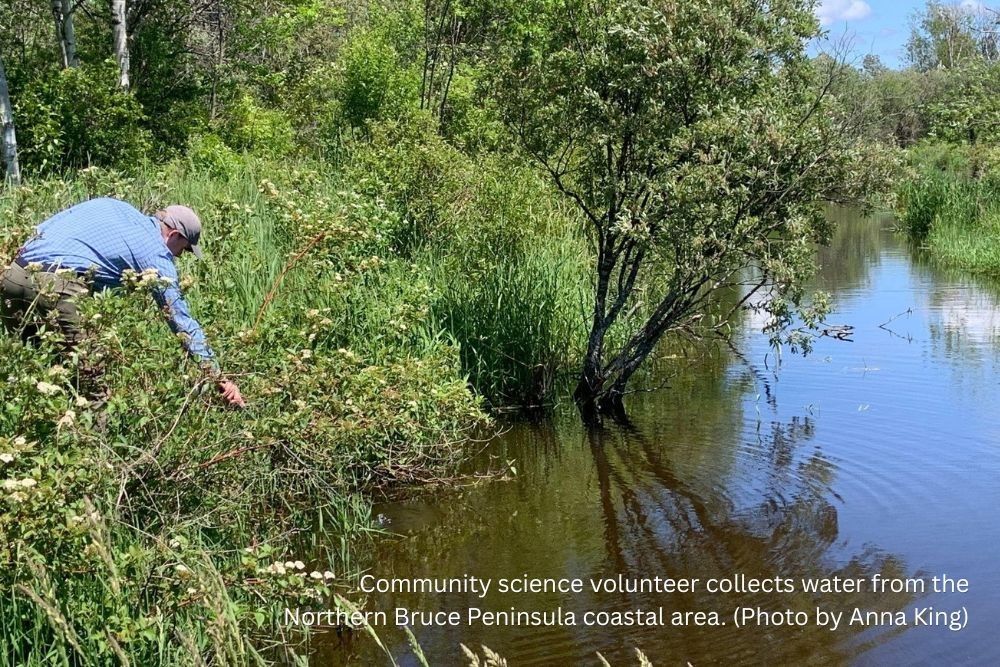
Now in the second year of the project, volunteers have been trained to test water quality and collect water samples monthly from the NBP coastal priority areas. Their ongoing observations are helping build a better picture of water conditions throughout the year at increased spatial resolutions along the BP coast.
The data collected will help to better understand environmental concerns such as nutrient levels, algal blooms, turbidity, erosion, shoreline hardening, and overall ecosystem health. This information will be used to determine where and what type of restoration and best management practices will provide the greatest impact to water quality on the peninsula and to Lake Huron.
In addition to water monitoring, the project also provides opportunities for volunteers to participate in hands-on workshop training in aquatic biomonitoring, drone use for environmental monitoring, shoreline surveys and other community science activities. Educational workshops will also provide additional opportunities to learn about local ecosystems and the work that is being done to protect and restore them.
An important part of the project is data sharing, and making the information collected accessible and publicly available. Data will be shared through open-access platforms, and contribute to future reports on the health of the local watersheds, as well as broader Great Lakes research and decision making.
By bringing local members of the community into the monitoring process, BPBA is hoping to bridge the gap between local knowledge and scientific data.
Stay connected with the Bruce Peninsula Biosphere Association for upcoming opportunities to learn, participate, and become a citizen scientist in your community.
Learn more on the Bruce Peninsula Biosphere Association website.